
24 Sep 2026 · Enric Massó · Politics & History · Technology & AI
Regulation Is Not the Same as Control
Europe is very good at writing rules for technology. This is not a criticism. Rules matter, particularly when technology affects privacy, competition, safety, public administration and basic rights. The European Union has also become…
The distinction has become harder to ignore. In its own Digital Decade reporting, the European Commission has repeatedly identified strategic dependencies in areas such as semiconductors, cloud infrastructure, AI and cybersecurity. In June 2026 it went further, proposing a technological sovereignty package covering chips, cloud and AI capacity, and open source. Whatever one thinks of the individual policies, the diagnosis is revealing: regulation alone does not create technological capacity.
A market can set excellent rules for a service and still depend heavily on external companies to provide it.
The comfortable version of sovereignty
Technological sovereignty is sometimes discussed as if the objective were to build a European copy of everything. European cloud, European chips, European search engine, European AI, preferably with twelve stars somewhere on the login screen. That would be a very expensive way to misunderstand the problem.
Modern economies are built on interdependence. Europe imports technology and exports technology. American companies depend on European equipment, Asian manufacturing and global supply chains. Trying to eliminate dependence would be both unrealistic and, in many cases, economically foolish.
The more useful question is what happens when a dependency becomes difficult to replace. If a European company relies on a foreign software supplier, that is not automatically a sovereignty problem. If the supplier changes price, terms, functionality or strategic direction and the customer has credible alternatives, the dependence remains manageable. If moving away would require years, data cannot be transferred cleanly, skills have disappeared internally and the only realistic replacements depend on the same underlying infrastructure, the situation is different.
Control does not have to mean ownership. It can mean options.
This is where regulation and capability start to diverge. Regulation can constrain behaviour, set conditions for market access and establish rights. What it cannot do by itself is manufacture an advanced semiconductor, create a competitive cloud ecosystem, preserve engineering knowledge or make a substitute available at the moment one is needed. You can regulate a dependency without having solved it.
Freedom of action is a practical test
For me, the useful test is not whether Europe can call a technology European. It is whether Europe retains meaningful freedom of action when circumstances change. Can a public administration switch provider without losing operational continuity? Can an industrial company obtain a critical component from another source within a tolerable period? Can data and workloads move? Does enough technical capability remain inside Europe to understand, adapt and operate essential systems? Are there several dependencies, or one dependency disguised as a supply chain?
Those questions are less exciting than technological independence, but they lead to better decisions. They also make sovereignty proportional. A bakery does not need sovereign infrastructure for every online booking. A hospital, energy network, defence system or public administration may reasonably care about dependencies that would be irrelevant for a low-risk consumer service. Not every foreign supplier is a strategic vulnerability, and not every European supplier removes one.
This is why I am wary of sovereignty becoming a label. Labels are easy to procure. Exit capacity is harder.
There is also a commercial reason to care about this distinction. A company does not experience sovereignty as a speech in Brussels; it experiences it through procurement choices, switching costs, contractual leverage and the availability of credible alternatives. Policy becomes tangible only when those options actually exist.
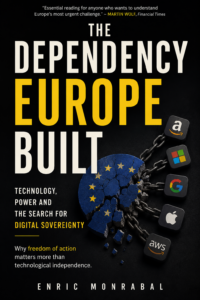
When I began working on The Dependency Europe Built, I expected the subject to be mainly about where technologies came from. It became increasingly clear that origin was only one part of the problem. The deeper issue was the architecture around the technology: who controls it, what can change, what alternatives exist and how long substitution would take.
Europe does not need to own everything it uses. But if something matters enough, it should probably know what it would do if the relationship changed. Rules can shape the playing field. Capacity determines whether you can still play.
Related book
The Dependency Europe Built Technology, Power and the Search for Digital Sovereignty
An examination of Europe’s technological dependencies and what digital sovereignty actually requires. The book argues that freedom of action depends less on technological autarky than on capability, diversification, substitutability and credible exit options.
Available on Amazon → [link pending]