
20 Dec 2025 · Enric Massó · Business & Management
A Good Business Idea Should Survive an Attempt to Kill It
People are very good at finding reasons why their own idea will work. Give us half an hour and a coffee and we can usually produce a convincing market, a plausible customer and several examples of people who have already told us it…
When somebody is thinking about starting a small business, I prefer a slightly more hostile exercise: before asking how to make the idea work, try to kill it. Not dramatically. No spreadsheets with forty tabs and no consultant arriving with a framework. Just make a serious attempt to prove that the idea is weaker than it looks.
Who exactly pays? Why would they change what they do now? How often does the problem occur? Is the person who loves the idea also the person who signs the invoice? What happens if sales take twice as long as expected? Can the business still make sense when you include your own time rather than treating it as a free natural resource? These questions are not pessimism. They are cheap.
Enthusiasm is useful, but it is not evidence
A new business often begins with something real: skill, frustration, an opportunity spotted at work, a hobby that people already ask you to do for them, or a product you cannot understand why nobody is selling properly. That initial conviction matters because building anything from scratch requires a degree of unreasonable persistence. The danger is allowing persistence to do the job of verification.
Friends are particularly unhelpful here, usually because they are being nice. “I would definitely buy that” is one of the most expensive sentences in entrepreneurship if you interpret it literally. The useful question is not whether someone likes the idea. It is what they do when buying requires a real decision: money, time, inconvenience, switching supplier or accepting some risk.
This is why I am suspicious of elaborate preparation before the first serious test. A beautiful website, carefully chosen software, a logo, a CRM and a twelve-month content plan can create the sensation that a business is advancing while leaving the central uncertainty untouched. Will anyone pay enough, often enough, for this to make sense?
You do not need to prove the whole company before starting. You need to identify the assumptions that could make the company pointless and attack those first.
Try to lose cheaply
The best early test is rarely the most sophisticated one. If the idea is a service, try to sell the service manually before building a system around it. If it is a product, find the smallest honest way to test demand before ordering enough stock to impress a warehouse. If the proposition depends on customers behaving in a particular way, observe whether they actually do.
A failed test can be excellent news if it is cheap enough. You have bought information. The expensive version is discovering the same thing after signing a lease, ordering inventory, financing equipment or spending six months building something that solves the wrong problem beautifully.
This is also why “minimum” should not mean shabby. A crude test still has to test the real proposition. If your product depends on trust, a deliberately amateur presentation may tell you only that customers dislike amateur presentations. If your service depends on speed, a manual process that takes three days may test the wrong thing. Simplify the machinery, not the value you are trying to validate.
The point is not to eliminate risk. A business with no uncertainty is usually a business somebody has already built. The point is to choose which risks deserve money before you know the answer.
I have always found this a more useful definition of prudence than writing a perfect plan. A plan can make uncertainty look organised. A good test reduces it.
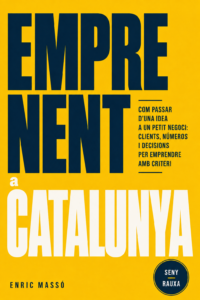
When I was shaping Emprenent a Catalunya, this became one of the ideas I kept returning to: do not ask an idea to prove that it deserves your love. Ask it to survive your suspicion. If it does, you have not proved that the business will succeed. Nothing can give you that. But at least you have earned the right to take the next risk.
Related book
Emprenent a Catalunya
A practical guide for turning a business idea into a small, workable activity in Catalonia without startup mythology or unnecessary complexity. It focuses on customers, money, operations, risk and the decisions that matter before the business becomes expensive.
Available on Amazon → [link pending]