
11 Sep 2026 · Enric Massó · Politics & History
A Declaration Is a Moment. Governing Is the Hard Part.
Political declarations are attractive because they compress an enormous conflict into a visible moment. There is a podium, a text, a vote, a flag, perhaps a crowd. Everybody understands that something has happened, even when nobody…
Government is less photogenic. It is budgets being executed on Monday morning. Salaries arriving. Schools opening. Courts, police, tax systems, hospitals, procurement, energy, communications and public records continuing to function. It is thousands of decisions made by institutions and people who may not share the same view of the political crisis at all.
That distinction is useful far beyond any particular independence movement. A political project can possess legitimacy among supporters, a coherent constitutional argument or significant electoral backing and still face a separate question: can institutions continue to perform their functions through a serious conflict over sovereignty?
The OECD uses a fairly unromantic language when it talks about resilient government: the ability to absorb disruption, adapt and maintain core public functions. That is not the language of political symbolism, but it is close to the language of actual state capacity.
Politics gets the attention. Continuity carries the weight.
In normal times, much of government is invisible precisely because it works. A payment reaches a supplier. A database responds. A local authority knows which rule applies. A public employee has legal authority to sign something. Banks recognise the account. Courts know which law they are applying. Other administrations know who can commit the institution.
A constitutional crisis makes those boring relationships suddenly political. Who has authority? Which instructions are lawful? Which institution controls which asset? What happens when two legitimate-looking chains of command produce incompatible orders? Can public services continue while courts, governments or administrations contest the legal basis of the transition?
These are not arguments for or against any particular constitutional outcome. They are the mechanics underneath it. They also explain why political control is not binary. An institution may control a building but depend on another administration for financing. It may have staff but not unquestioned legal authority. It may possess political legitimacy among a large part of the population while lacking recognition elsewhere. It may be able to announce a decision immediately and require months or years to make the administrative consequences stable.
The gap between declaring and governing is where many simplified political stories become uncomfortable.
The morning after is made of dependencies
This is one reason I find hypothetical political scenarios more interesting when they begin after the dramatic event rather than ending there.
Imagine any serious constitutional rupture, not only in Spain. The visible question is usually who prevails politically. The practical questions multiply much faster. How are taxes collected? Which administration has access to funds? Who guarantees public debt? Which legal decisions are recognised? What happens to contracts? How do businesses plan when the institutional destination is uncertain? How do governments maintain public confidence without pretending that uncertainty has disappeared?
There is no universal sequence. Constitutions differ, institutions differ and international responses differ. Any serious analysis has to separate law, political legitimacy, administrative capacity, economic behaviour and external recognition instead of pretending they are one thing.
This also makes predictions unusually unreliable. Political actors react to one another. Courts intervene. Governments change strategy. Businesses delay decisions or adapt. Citizens who agree on the destination may disagree about the cost. Institutions that look weak can prove resilient; apparently firm positions can move.
The useful question is therefore not “What would definitely happen?” It is “What would have to keep working while nobody yet knows exactly what will happen?”
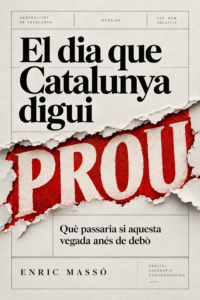
That is the question behind El dia que Catalunya digui prou. The book starts from a hypothetical severe political crisis between Catalonia and Spain and examines it through governability, institutions, finance, legitimacy, resilience and consequences rather than treating a declaration as either the magical creation of a state or the automatic end of the story.
Whatever political conclusion a reader brings to the subject, one thing seems hard to avoid: sovereignty is discussed in speeches, but experienced through systems. The television moment may last an afternoon. The administrative morning after is where the difficult part begins.
Related book
El dia que Catalunya digui prou Què passaria si aquesta vegada anés de debò
A strategic examination of a hypothetical high-intensity political rupture between Catalonia and Spain, focusing on institutions, governability, finance, legitimacy, resilience, information, economic effects and international constraints rather than slogans.
Available on Amazon → [link pending]